
A person who sleeps eight hours a night will spend roughly a third of their life asleep, yet for most of human history, scientists had almost no idea what that time was actually doing for the body. That has changed dramatically in the last few decades. Sleep is no longer viewed as simple “downtime”; it is now understood as an active, highly organized biological process that repairs tissue, consolidates memory, regulates hormones, and clears metabolic waste from the brain.
| TL;DR — What Is Sleep? Sleep is a naturally recurring state of reduced consciousness and lowered responsiveness to the outside world, marked by predictable cycles of brain activity, muscle relaxation, and shifting body functions. It is not passive rest, during sleep, the brain and body carry out repair, memory processing, and waste clearance that cannot happen efficiently while awake. |
What Is Sleep?
Sleep is a reversible state in which the brain reduces its responsiveness to external stimuli while cycling through distinct patterns of electrical activity. Unlike simply resting with eyes closed, sleep involves measurable, structured changes in brain waves, eye movement, muscle tone, breathing, and heart rate.
Despite decades of research, sleep science still has open questions. Researchers have a strong understanding of what happens physiologically during sleep, which brain regions activate, which hormones rise and fall, which chemicals build up during waking hours and are cleared during sleep, but there is less certainty about exactly why some of these processes evolved the way they did, or why dreaming occurs in the specific way it does.
At a high level, during sleep the brain doesn’t simply “switch off.” Certain regions become more active than during wakefulness, particularly during REM (rapid eye movement) sleep. Meanwhile, the body’s systems shift into a different operating mode: body temperature drops slightly, heart rate and breathing slow and become more regular during deep sleep, growth hormone release increases, and the immune system recalibrates.
Why Do We Sleep? The Core Functions
Sleep serves several overlapping biological functions, and researchers generally agree these functions work together rather than operating in isolation.
Energy Conservation
One of the oldest theories of sleep is that it conserves energy. Metabolic rate drops during sleep, particularly during deep non-REM sleep, reducing the body’s overall caloric demand during hours when hunting, foraging, or other productive activity would be inefficient anyway (most humans, like many mammals, are far less effective at those tasks in the dark). While energy conservation alone doesn’t fully explain the complexity of modern sleep architecture, it remains part of the broader picture.
Cellular and Physical Repair
Sleep, particularly deep non-REM sleep, is associated with increased release of growth hormone, which supports tissue growth and repair. Protein synthesis, muscle recovery, and immune-system activity involved in fighting infection also appear to be closely tied to adequate sleep. This is part of why illness and intense physical training both tend to increase the body’s drive for sleep.
Memory Consolidation & the Brain’s “Cleanup” Process
During sleep, the brain reorganizes and strengthens the connections formed during the day, a process researchers call memory consolidation. Different sleep stages appear to support different types of memory: deep non-REM sleep is linked with consolidating factual and declarative memories, while REM sleep is more closely associated with emotional processing and procedural (skill-based) memory.
A more recently studied function involves the glymphatic system, a network that helps clear metabolic waste products, including proteins that build up in the brain during waking hours, out of brain tissue. Research in this area, much of it originating from work in animal models with growing human evidence, suggests that this clearance process is significantly more active during sleep than during wakefulness. Scientists are still working to fully map how this process functions in humans and what its long-term implications are, so this should be understood as an active and evolving area of research rather than a fully settled one.
How Much Sleep Do You Really Need?
Sleep needs vary by age, and general guidelines, most notably those published by the National Sleep Foundation and endorsed in large part by organizations such as the American Academy of Sleep Medicine , offer recommended ranges rather than fixed targets.
| Age Group | Recommended Sleep |
| Newborns (0–3 months) | 14–17 hours |
| Infants (4–11 months) | 12–15 hours |
| Toddlers (1–2 years) | 11–14 hours |
| Preschoolers (3–5 years) | 10–13 hours |
| School-age children (6–13 years) | 9–11 hours |
| Teenagers (14–17 years) | 8–10 hours |
| Young adults (18–25 years) | 7–9 hours |
| Adults (26–64 years) | 7–9 hours |
| Older adults (65+ years) | 7–8 hours |
Individual Variability
These ranges are population averages, not universal rules. A small percentage of people appear to be naturally “short sleepers” who function well on notably less sleep than typical guidelines suggest, often linked to specific genetic variations. This is uncommon, though, most people who believe they function fine on five or six hours are actually operating with a sleep debt they’ve adapted to tolerating, not genuinely thriving on less sleep.
Quality vs. Quantity
Hours in bed are not the same as hours of restorative sleep. Someone who sleeps eight hours but wakes up repeatedly throughout the night, or who has undiagnosed sleep apnea disrupting their sleep architecture, may feel far less rested than someone who sleeps seven consolidated hours. Sleep efficiency, the percentage of time in bed actually spent asleep, and the proportion of time spent in deep and REM sleep both matter alongside total duration.
When to Talk to a Healthcare Provider About Sleep Needs
Consider speaking with a healthcare provider if you consistently need significantly more or less sleep than typical ranges suggest, if you feel unrefreshed despite adequate time in bed, or if you experience loud snoring, gasping during sleep, excessive daytime sleepiness, or difficulty falling or staying asleep that persists for several weeks.
Do You Need to Get All Your Sleep at Once?
Not necessarily, though the answer depends on culture, lifestyle, and individual biology.
Historical and Cultural Sleep Patterns
Before widespread artificial lighting, some historical evidence suggests segmented sleep, sleeping in two separate blocks with a period of quiet wakefulness in between, was common in parts of pre-industrial Europe. Biphasic sleep patterns, including a midday sleep period, are also a longstanding cultural tradition in many regions, most visibly in the siesta traditions of parts of the Mediterranean and Latin America. Modern researchers generally agree that humans are biologically flexible enough to adapt to either consolidated or segmented sleep patterns, provided total restorative sleep needs are met.
Napping Science
Short naps can restore alertness without significantly disrupting nighttime sleep, but timing and length matter:
- Short naps (roughly 10–20 minutes) tend to boost alertness and mood quickly without causing grogginess.
- Longer naps (60–90 minutes) allow a full sleep cycle including deep and REM sleep, which can support memory consolidation, but may cause temporary grogginess on waking (sleep inertia).
- Naps taken too late in the day, or naps longer than about 30 minutes for people who struggle with nighttime sleep, can reduce “sleep pressure” and make it harder to fall asleep at night.
- People with insomnia are often advised by clinicians to limit or avoid napping, since it can worsen nighttime sleep difficulty.
The Stages of Sleep, Explained
Sleep is organized into repeating cycles made up of two broad categories: NREM (non-rapid eye movement) sleep and REM (rapid eye movement) sleep. A full cycle typically lasts around 90 minutes, and a night of sleep usually includes four to six cycles, with the proportion of REM sleep increasing in later cycles.
Stage 1 NREM: Light Transition Sleep
Stage 1 is the brief transition between wakefulness and sleep, typically lasting only a few minutes. Muscle activity slows, and some people experience hypnic jerks, sudden muscle twitches, during this stage. A person woken during Stage 1 may not even realize they were asleep.
Stage 2 NREM: Established Sleep
Stage 2 makes up the largest share of total sleep time in most adults. Body temperature drops, heart rate slows further, and the brain produces characteristic bursts of activity called sleep spindles and K-complexes, which are thought to play a role in memory processing and in filtering out external stimuli so sleep isn’t easily disrupted.
Stage 3 NREM: Deep Sleep
Stage 3, often called slow-wave or deep sleep, is the most physically restorative stage. Brain activity slows to large, synchronized slow waves, blood pressure and breathing reach their lowest points, and this is when most growth hormone release and physical repair occurs. Deep sleep is concentrated in the earlier part of the night.
Waking someone during deep sleep produces sleep inertia, a period of grogginess, disorientation, and slowed cognitive function that can last anywhere from several minutes to, in some cases, longer. This is why waking abruptly from deep sleep (for example, from a loud alarm early in the night) often feels far worse than waking naturally near the end of a sleep cycle.
REM Sleep
REM sleep is marked by rapid eye movements, near-total loss of voluntary muscle tone (a protective mechanism that prevents the body from acting out dreams), and brain activity that resembles wakefulness in many ways. Most vivid dreaming occurs during REM sleep. REM periods are shorter earlier in the night and lengthen with each subsequent cycle, which is why the most memorable dreams often occur in the early morning hours, closer to natural waking.
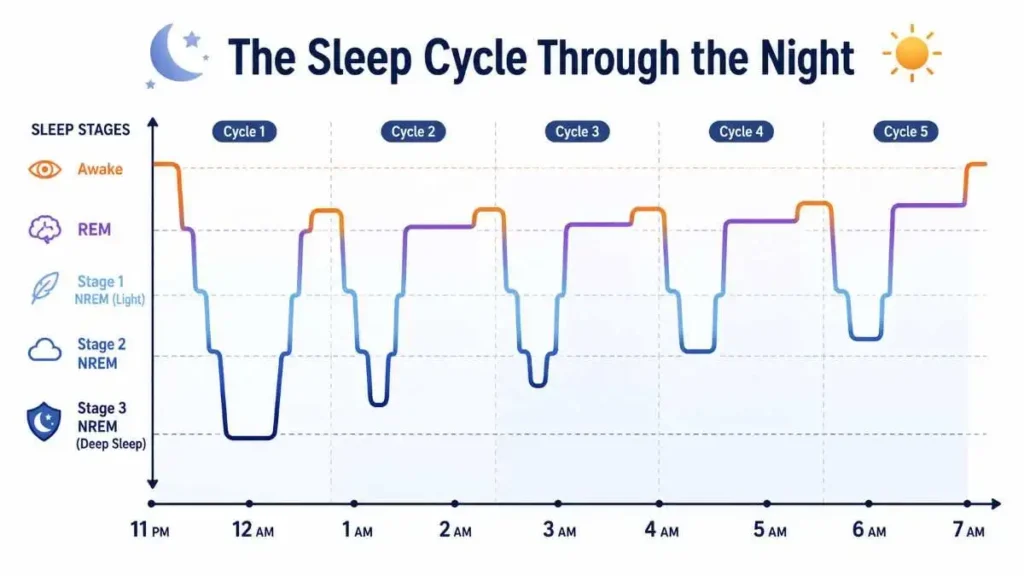
Across a full night, cycles repeat roughly every 90 minutes, with deep sleep concentrated earlier in the night and REM sleep becoming more prominent in the final cycles before natural waking.
Common Sleep Disorders
Sleep disorders are generally grouped into several broad categories. The following is an educational overview, not a diagnostic tool, only a qualified healthcare provider can diagnose a sleep disorder.
Insomnia
Insomnia involves persistent difficulty falling asleep, staying asleep, or waking too early, despite adequate opportunity to sleep, often accompanied by daytime impairment. It can be short-term (often tied to stress or a specific event) or chronic (lasting three months or longer).
Sleep-Disordered Breathing
This category includes obstructive sleep apnea, in which the airway repeatedly narrows or collapses during sleep, and central sleep apnea, in which the brain temporarily fails to signal the body to breathe. Common signs include loud snoring, gasping or choking during sleep, and excessive daytime sleepiness.
Hypersomnolence Disorders
These involve excessive daytime sleepiness despite adequate or even prolonged nighttime sleep. Narcolepsy, one condition in this category, can also involve sudden muscle weakness triggered by strong emotion (cataplexy) and disrupted nighttime sleep patterns.
Circadian Rhythm Disorders
These occur when a person’s internal sleep-wake clock is misaligned with the external day-night schedule, as seen in shift work disorder, jet lag, or delayed/advanced sleep phase patterns, where a person’s natural sleep and wake times are significantly shifted later or earlier than conventional schedules.
Parasomnias
Parasomnias are unusual behaviors or experiences that occur around sleep, including sleepwalking, sleep talking, night terrors, and REM sleep behavior disorder (in which the normal muscle paralysis of REM sleep is incomplete, allowing a person to physically act out dreams).
Sleep-Related Movement Disorders
This category includes restless legs syndrome, characterized by an uncomfortable urge to move the legs, typically worse in the evening, and periodic limb movement disorder, involving repetitive limb movements during sleep that can fragment sleep quality.
When to See a Doctor
Consider seeing a healthcare provider if sleep difficulties persist for several weeks, significantly affect daytime functioning, involve loud snoring or breathing pauses reported by a bed partner, or involve unusual behaviors during sleep that pose a safety risk.
How Sleep Problems Are Diagnosed
Several standardized tools help clinicians evaluate sleep disorders:
- Polysomnogram (PSG): An overnight, in-lab study that measures brain waves, eye movement, muscle activity, heart rate, breathing, and blood oxygen levels simultaneously, the most comprehensive sleep study available.
- Home sleep apnea test (HSAT): A simplified, portable version of a sleep study used specifically to screen for obstructive sleep apnea, typically measuring breathing, oxygen levels, and heart rate.
- Electroencephalogram (EEG): Measures electrical brain activity and is a core component of a polysomnogram; it can also be used on its own in some diagnostic contexts.
- Actigraphy: Involves wearing a small motion-sensing device, usually on the wrist, over several days to weeks to track rest-activity patterns and estimate sleep-wake timing in a person’s natural environment.
- Multiple Sleep Latency Test (MSLT): Measures how quickly a person falls asleep during several daytime nap opportunities, used primarily to evaluate excessive daytime sleepiness and conditions like narcolepsy.
- Maintenance of Wakefulness Test (MWT): The inverse of the MSLT, measures a person’s ability to stay awake during quiet daytime periods, often used to assess whether someone can safely perform tasks like driving.
Sleep Hygiene: A Practical, Actionable Playbook
Sleep hygiene refers to the habits and environmental factors that influence sleep quality. Small, consistent changes tend to matter more than occasional large efforts.
Keep a Consistent Schedule
Going to bed and waking up at roughly the same time every day, including weekends, helps stabilize the circadian rhythm. Large swings in wake time (a “social jet lag” effect from sleeping in significantly later on weekends) can make Monday mornings feel like a mild form of jet lag.
Build a Wind-Down Routine
A consistent 20–30 minute pre-sleep routine, dimming lights, light stretching, reading, or a warm shower — signals to the brain that sleep is approaching. The specific activity matters less than the consistency and the fact that it’s calming rather than stimulating.
Manage Light Exposure
Bright light, especially blue-wavelength light, suppresses melatonin production and delays the body’s internal signal that it’s time to sleep. Rather than a blanket “avoid all screens” rule that’s hard to follow realistically, a more practical approach is dimming screen brightness, using night-mode settings in the hour or two before bed, and prioritizing bright light exposure earlier in the day to reinforce a strong wake signal in the morning.
Time Caffeine and Alcohol Carefully
Caffeine has a half-life of roughly five to six hours in most adults, meaning a substantial portion is still active in the body well into the evening if consumed in the afternoon. Alcohol, despite its sedating effect, tends to fragment sleep in the second half of the night and reduces REM sleep, which is why a “nightcap” often leads to lighter, more disrupted sleep even if it helps someone fall asleep faster initially.
Time Exercise Thoughtfully
Regular physical activity is associated with better sleep quality, but vigorous exercise very close to bedtime can raise heart rate, core temperature, and alertness in a way that delays sleep onset for some people. Finishing more intense workouts a few hours before bed, when possible, tends to work better for most people.
Optimize the Bedroom Environment
A cool room (generally cited as somewhere in the roughly 60–67°F / 15–19°C range for most adults), minimal light, and reduced noise all support sleep onset and continuity. A comfortable mattress and pillow, matched to individual preference, also play a meaningful role.
Sleep Medications & Natural Aids — What to Know
This section is educational only and is not a substitute for medical advice. Always consult a healthcare provider before starting any sleep medication or supplement, especially if you take other medications, are pregnant, or have an underlying health condition.
Prescription Categories
Several broad classes of prescription medication are used to treat insomnia and other sleep difficulties, including sedative-hypnotics that act on specific brain receptors to promote sleep, certain antidepressants prescribed off-label at low doses for their sedating effects, and, less commonly today, benzodiazepines. Each class carries different risks, including potential for dependence, next-day grogginess, or interactions with other medications, which is why prescribing decisions should always be made individually with a healthcare provider.
Over-the-Counter and Natural Options
- Melatonin: A hormone the body produces naturally in response to darkness. Supplemental melatonin is most often used to help shift sleep timing (such as for jet lag) rather than as a general sedative, and appropriate use and timing vary by individual.
- Antihistamines (such as diphenhydramine): Available in many OTC sleep aids for their sedating side effect, though they can cause next-day grogginess and are generally not recommended for regular long-term use.
- Valerian root and other herbal supplements: Used traditionally for sleep support; scientific evidence on effectiveness is mixed, and supplement quality and dosing are not as tightly regulated as prescription medications.
Because interactions, side effects, and appropriate use vary significantly by individual, this article intentionally does not provide dosage guidance, that determination should always come from a healthcare provider familiar with your health history.
Common Sleep Myths vs. Facts
| Myth | Fact |
| You can fully “catch up” on lost sleep over a weekend. | Extra sleep can partially offset short-term sleep debt and improve how you feel, but research suggests some effects of sleep deprivation — particularly on metabolic and cognitive measures — aren’t fully reversed by a couple of catch-up nights. |
| Alcohol helps you sleep better. | Alcohol can shorten the time it takes to fall asleep, but it fragments sleep and reduces REM sleep later in the night, generally lowering overall sleep quality. |
| Everyone needs exactly 8 hours of sleep. | Recommended ranges (typically 7–9 hours for most adults) reflect population averages; individual needs vary based on age, genetics, and health. |
| Snoring is always harmless. | Occasional light snoring is common and often harmless, but loud, frequent snoring — especially with gasping or pauses in breathing — can be a sign of obstructive sleep apnea and is worth discussing with a doctor. |
| Older adults need much less sleep than younger adults. | Recommended sleep duration decreases only slightly with age (from about 7–9 hours to about 7–8 hours); older adults often experience lighter, more fragmented sleep rather than a genuinely lower biological need for it. |
Effects of Not Getting Enough Sleep
Short-Term Effects
Even a single night of inadequate sleep measurably affects concentration, reaction time, mood regulation, and decision-making. Sleep-deprived individuals may experience microsleeps, brief, involuntary lapses into sleep lasting a few seconds, often without realizing it, which is part of why drowsy driving is considered comparably dangerous to impaired driving in some research.
Long-Term Health Associations
Chronic insufficient sleep is associated, in large population studies, with higher rates of cardiovascular issues, metabolic changes linked to weight gain and insulin resistance, and impaired long-term cognitive function. It’s important to note these are associations observed in research, not guarantees of a specific outcome for any individual, sleep is one factor among many (including diet, activity level, genetics, and overall health) that contribute to these risks.
What Is Sleep Debt?
Sleep debt is the cumulative gap between the sleep your body needs and the sleep you actually get. It builds gradually, losing an hour a night for a week creates a meaningfully larger deficit than a single short night, even though it may not feel as immediately noticeable.
Sleep debt doesn’t fully reverse with one long “recovery” night; research suggests it can take multiple nights of adequate sleep to restore normal function after an extended period of insufficient sleep, and some effects, particularly on metabolic markers, appear to persist even after subjective grogginess resolves. The most effective approach to sleep debt is prevention: prioritizing consistent, adequate sleep rather than relying on periodic catch-up sleep to offset a chronic shortfall.
FAQs
What is the best sleep position?
There’s no single “best” position for everyone, but side sleeping is often recommended for reducing snoring and mild sleep apnea symptoms and easing acid reflux. Back sleeping can worsen snoring and apnea for some people, while stomach sleeping is generally discouraged due to added strain on the neck and spine. The right position ultimately depends on individual comfort and any underlying health conditions.
Can you survive on less sleep long-term?
Most adults cannot function optimally on significantly less sleep than recommended for extended periods, even if they feel adapted to it. True genetic short sleepers exist but are rare; for the vast majority of people, chronic short sleep carries measurable costs to cognitive performance and long-term health, even if those costs aren’t immediately obvious day to day.
What causes vivid dreams?
Vivid dreams occur most often during REM sleep, when brain activity closely resembles wakefulness. Dream vividness can be influenced by REM sleep duration, certain medications, stress levels, and sleep disruption; researchers don’t fully understand why dream content takes the specific forms it does, and this remains an active area of study.
Is it bad to wake up during deep sleep?
Waking during deep sleep typically causes sleep inertia, grogginess and slowed thinking that can last several minutes or longer, but it is not inherently harmful on an occasional basis. It simply tends to feel worse than waking during lighter sleep stages or naturally near the end of a sleep cycle.
Does sleep quality matter more than quantity?
Both matter, and they interact. Adequate total sleep time provides the opportunity for restorative processes to occur, while poor sleep quality (frequent waking, low sleep efficiency, disrupted sleep architecture) can prevent someone from feeling rested even after enough total hours. Neither factor fully compensates for a serious deficit in the other.
How do I know if I have a sleep disorder?
Persistent signs, difficulty falling or staying asleep, loud snoring or gasping during sleep, excessive daytime sleepiness despite adequate time in bed, or unusual behaviors during sleep, that continue for several weeks and affect daily functioning are worth discussing with a healthcare provider, who can determine whether further evaluation or a sleep study is appropriate.
Does napping make up for a bad night’s sleep?
A short nap can help offset acute sleepiness and improve alertness after a poor night’s sleep, but it doesn’t fully replace the restorative processes of full, uninterrupted nighttime sleep, particularly extended deep and REM sleep periods that occur later in a normal sleep cycle.
What is sleep latency?
Sleep latency is the amount of time it takes to fall asleep after getting into bed. A typical range is roughly 10–20 minutes; falling asleep much faster can be a sign of significant sleep deprivation, while consistently taking much longer may indicate insomnia or another underlying issue.
Key Takeaways
- Sleep is an active biological process, not passive rest, involving distinct stages that each serve different repair and memory functions.
- Most adults need 7–9 hours of sleep per night; needs vary somewhat by age and individual biology.
- Sleep cycles through NREM Stages 1–3 and REM sleep roughly every 90 minutes, with deep sleep concentrated early in the night and REM sleep increasing toward morning.
- Both sleep quantity and sleep quality matter, consistently fragmented sleep can leave someone feeling unrested even with adequate total hours.
- Sleep debt accumulates gradually and isn’t fully offset by occasional catch-up sleep; consistency is more effective than compensation.
- Persistent sleep difficulties, loud snoring with gasping, or excessive daytime sleepiness are worth discussing with a healthcare provider.
- Always consult a healthcare provider before starting any sleep medication or supplement.

I have 8+ years of experience in pharmaceutical research and health content writing.
I enjoy turning complex medical information into simple, clear, and easy-to-understand content that people can actually trust and use.
I’ve worked with healthcare brands to create content that is accurate, well-researched, and helpful for readers.
My main focus is on pharmaceutical writing, medical research, and SEO-friendly health content.
Currently, I’m working with Staminite, where I contribute to creating quality pharmaceutical content for a global audience.